 Native
Your customer intelligence,
made queryable.

A Native digital twin is a dynamic model of a consumer or audience, grounded in real human evidence and built to be questioned, tested, and validated as the decision changes.
Use them to explore new scenarios, compare responses, and bring the customer perspective into decisions without starting the research over.
See how a twin is built
01Digital twin anatomy
How evidence becomes
a population.
Millions of qualitative and quantitative signals can sit across an organization and the market: research, transactions, CRM, reviews, behavioral data, social discourse, demographic structure, and more.

Native brings those signals into a common model, resolves patterns across them, and uses them to construct a population of individually modeled consumers with distinct attitudes, behaviors, constraints, habits, preferences, and contradictions.
The evidence is normalized into a shared intelligence layer, creating a living lattice of relationships between people, behaviors, attitudes, and market signals.
The result is a living population your teams can question, test, and return to as the evidence evolves.
02Built around your universe
Make the twin
native to your market.
Shape the population with the evidence closest to your business, then deepen it with Native research, benchmarks, and the signals surrounding your category.

Each layer adds a different kind of context, making the twin increasingly native to the customers, market, and decisions your organization works with.
Bring forward the evidence that matters most to the audience, market, and decision you want to understand.
03Modeling
From millions of signals to a population you can question.
Native normalizes the inputs, reconciles differences across sources, and resolves the patterns that distinguish one consumer from another.

Rather than flattening the evidence into a single average, the model preserves the variation that matters: attitudes, behaviors, budgets, needs, preferences, constraints, tradeoffs, and contradictions.
Those patterns become a population of individually modeled consumers that can respond to new questions while remaining grounded in the evidence that shaped them.
04How a twin takes shape
Assemble. Construct. Prove.
Building a twin is not one modeling step. It is a controlled process for defining the audience, constructing the population, and proving that it behaves credibly enough for the work it is meant to support.

05The twin
Grounded. Validated.
Ready to question.
What began as distributed evidence is now a dynamic, queryable model of a consumer or audience.

The twin carries attitudes, behaviors, budgets, habits, preferences, constraints, and contradictions into new questions and scenarios, so your team can keep working with the customer understanding already in place.
Ask something new without rebuilding what you already know.
06Fidelity controls
Choose how the twin
works with the evidence.
Every setting stays grounded in the same underlying evidence. Fidelity controls how the twin uses that evidence for the task at hand, from highly literal and directly traceable responses to broader synthesis across related signals.



07Trace the answer
Follow the response
back to the evidence.
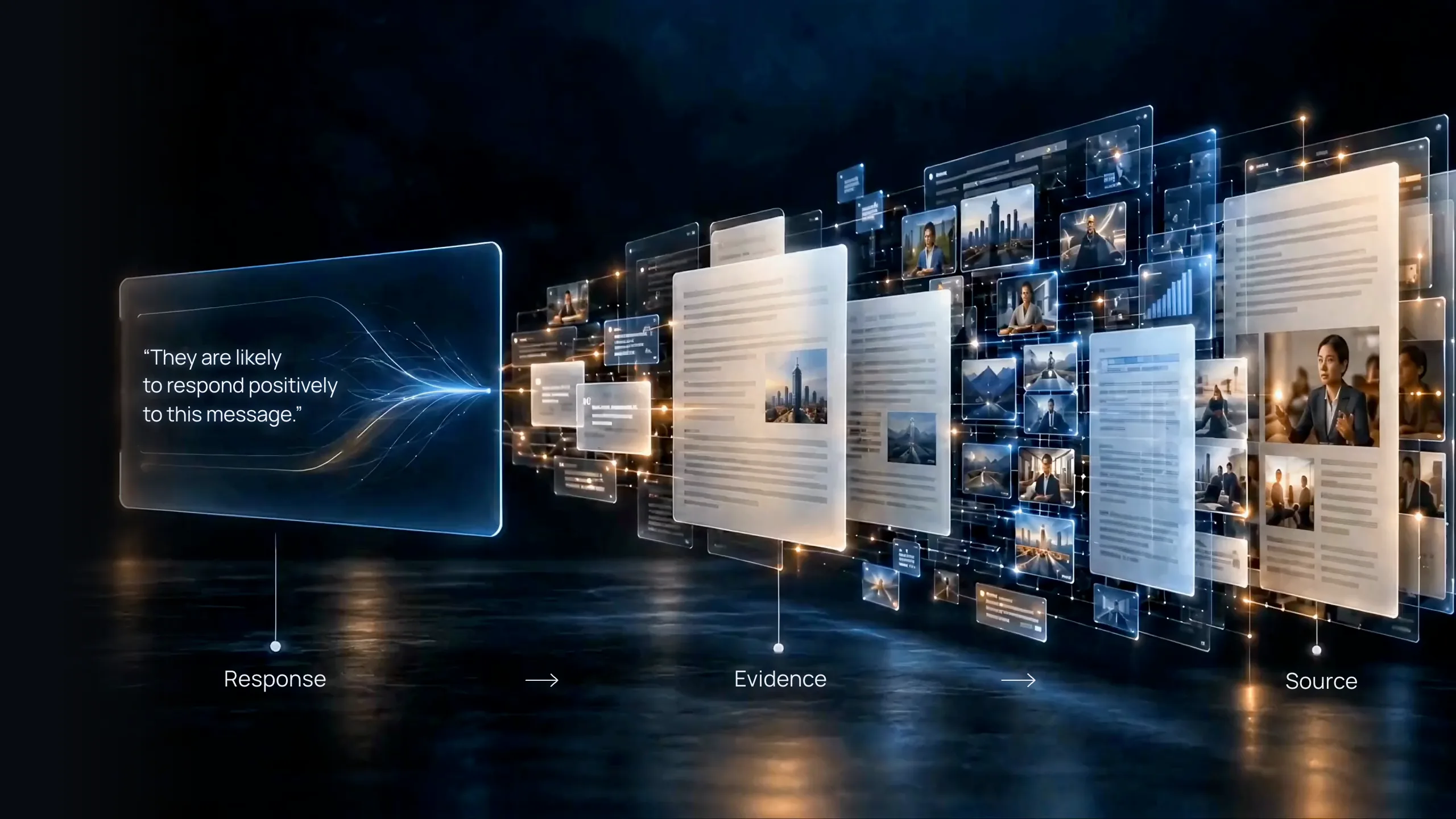
See what informed the answer and trace the supporting evidence back to its source.
08Now Ask
What happens if.
Change the price. Change the audience. Change the message, offer, assumptions, or scenario.

What if?
Illustrative outputs
Scenario A
High confidence
Purchase intent
62%
Price sensitivity
Medium
Scenario B
Medium confidence
Purchase intent
55%
Price sensitivity
Low
Scenario C
Medium confidence
Purchase intent
47%
Price sensitivity
High
Bring different sources of evidence into the decision and see what they change. Understand where confidence holds, where it moves, and which additional inputs would strengthen the decision.
Test the variables. Compare the paths. Build the evidence behind the call.
FAQ